Building a Python CLI with Typer: The Modern Approach to the Command Pattern
Posted on 11 Aug 2026
Introduction
You have already built the same Task Manager CLI twice. In Part 1 you used Python’s built-in argparse module and the Command Pattern to get a clean, extensible structure. In Part 2 you replaced argparse with Click — the code got shorter, type validation became automatic, and the Command Pattern survived without a shared execute(**kwargs) interface.
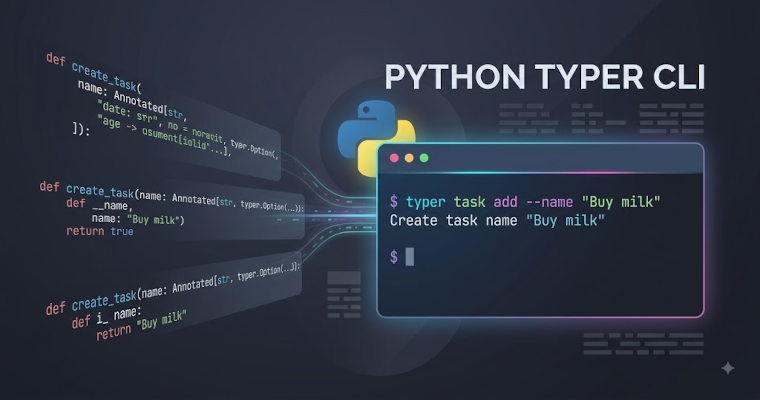
Now we do it a third time with Typer. Typer turns Python’s own type annotations into a complete CLI — no option decorator stacks, no explicit type parameters, just function signatures. The result is the most readable version of the three, and it is the one I use in my own projects.
You should read this article if:
- You have read Parts 1 and 2 and want to see the evolution complete.
- You want a CLI library that is natively type-safe and plays well with mypy and IDE autocompletion.
- You want a real-world reference showing Typer in a real project before committing to it.
argparse vs Click vs Typer at a Glance
Before diving into code, here is the complete picture:
| Property | argparse | Click | Typer |
|---|---|---|---|
| Where it comes from | Standard library | Third-party | Third-party (built on Click) |
| How commands are defined | add_subparsers() + add_parser() |
@click.command / @click.group decorators |
Annotated function signatures — no option decorators |
| Type conversion | Manual (type=int) |
Decorator parameter (type=int) |
Inferred from annotation (: int) |
| Validation on bad input | Manual | Automatic, built-in error message | Automatic, built-in error message |
| Sub-apps / command groups | Nested add_subparsers() |
@click.group |
typer.Typer() added via app.add_typer() |
--help generation |
From help= string |
From help= string |
From docstring + help= string |
| IDE autocompletion for params | None | Partial | Full — standard type hints |
| Lines of code (task add) | ~12 | ~4 | ~3 |
Typer is to CLIs what FastAPI is to web APIs: the same idea of driving behaviour from type annotations rather than from imperative configuration.
Why Typer?
Click removed the argparse boilerplate. Typer removes the option decorator stack.
To be precise: Typer still uses a decorator to register a command (@app.command()), just like Click. What disappears are all the @click.option and @click.argument decorators that pile up above every function in Click. With one option those are manageable; with four or five options the function itself disappears under a tower of decorators.
With Click, every option requires an explicit @click.option("--name", type=str, required=True) decorator. The type is declared twice — once in the decorator, once in the function signature — and they can silently drift apart. Typer merges the two: the function signature is the definition, and the single @app.command() decorator is the only one you need.
Two more practical gains:
- Docstrings become help text. Write
"""Deploy a new agent sandbox."""on a function and Typer uses it for--help. You document the code and the CLI at the same time. OptionalandAnnotatedwork as you expect.name: str | None = Noneis an optional option.Annotated[str, typer.Option(help="Task name")]adds metadata without a separate decorator.
Typer is built on top of Click, so every Click feature is still available if you need it. You are not giving anything up.
Installing Typer
uv add "typer[all]"
Breaking down the options:
typer— the core library[all]— installsrich(coloured output, formatted help pages) andshellingham(shell auto-completion detection); highly recommended for end-user CLIs
Running uv add records the dependency in pyproject.toml and updates uv.lock — no manual editing needed.
The Task Manager CLI — Code Walkthrough
The CLI syntax stays the same as in Parts 1 and 2:
python3 cli.py task add --name "Buy milk"
python3 cli.py task list
python3 cli.py task delete --id 1
python3 cli.py stats summary
python3 cli.py stats export --output report.csv
No external repository this time — all code lives inline in this article.
Project Structure
task-cli/
├── cli.py
└── commands/
    ├── __init__.py
    ├── base.py
    ├── add_task_command.py
    ├── list_task_command.py
    ├── delete_task_command.py
    └── stats_command.py
The structure is identical to Parts 1 and 2. Only cli.py changes significantly.
The Base Command Class
Same marker pattern introduced in the Click version — no shared execute() method, just a semantic boundary:
# commands/base.py
from abc import ABC


class Command(ABC):
    """Marker base class for CLI commands."""
The Concrete Command Classes
The command classes are unchanged from the Click version. Each method carries an explicit, typed signature:
# commands/add_task_command.py
from .base import Command


class AddTaskCommand(Command):
    def execute(self, name: str) -> None:
        with open("tasks.txt", "a") as f:
            f.write(name + "\n")
        print(f"Task added: {name}")
# commands/list_task_command.py
from .base import Command


class ListTaskCommand(Command):
    def execute(self) -> None:
        try:
            with open("tasks.txt") as f:
                tasks = [line.strip() for line in f if line.strip()]
        except FileNotFoundError:
            tasks = []
        if not tasks:
            print("No tasks found.")
            return
        print("Tasks:")
        for i, t in enumerate(tasks, 1):
            print(f"{i}. {t}")
# commands/delete_task_command.py
from .base import Command


class DeleteTaskCommand(Command):
    def execute(self, task_id: int) -> None:
        try:
            with open("tasks.txt") as f:
                tasks = [line.strip() for line in f if line.strip()]
        except FileNotFoundError:
            print("No tasks found.")
            return
        if task_id < 1 or task_id > len(tasks):
            print(f"Invalid task ID: {task_id}")
            return
        removed = tasks.pop(task_id - 1)
        with open("tasks.txt", "w") as f:
            f.write("\n".join(tasks))
        print(f"Task deleted: {removed}")
# commands/stats_command.py
import csv
import os
from .base import Command


class StatsCommand(Command):
    TASKS_FILE = "tasks.txt"

    def summary(self) -> None:
        tasks = self._load_tasks()
        print(f"You have {len(tasks)} task(s).")
        for i, t in enumerate(tasks, 1):
            print(f"{i}. {t}")

    def export(self, output: str) -> None:
        tasks = self._load_tasks()
        if not tasks:
            print("No tasks to export.")
            return
        with open(output, "w", newline="") as csvfile:
            writer = csv.writer(csvfile)
            writer.writerow(["ID", "Task"])
            for i, task in enumerate(tasks, 1):
                writer.writerow([i, task])
        print(f"Tasks exported to {output}")

    def _load_tasks(self) -> list[str]:
        if not os.path.exists(self.TASKS_FILE):
            return []
        with open(self.TASKS_FILE) as f:
            return [line.strip() for line in f if line.strip()]
The CLI Entry Point
This is where Typer replaces Click. Compare the structure to the Click version and notice what disappears: no @click.option decorator stacks, no explicit type= parameters.
# cli.py
from typing import Annotated
import typer
from commands.add_task_command import AddTaskCommand
from commands.list_task_command import ListTaskCommand
from commands.delete_task_command import DeleteTaskCommand
from commands.stats_command import StatsCommand

app = typer.Typer(help="Task Manager CLI", no_args_is_help=True)
task_app = typer.Typer(help="Manage tasks.", no_args_is_help=True)
stats_app = typer.Typer(help="Show or export task statistics.", no_args_is_help=True)

app.add_typer(task_app, name="task")
app.add_typer(stats_app, name="stats")


@task_app.command("add")
def task_add(
    name: Annotated[str, typer.Option("--name", "-n", help="Task name.")],
) -> None:
    """Add a new task."""
    AddTaskCommand().execute(name=name)


@task_app.command("list")
def task_list() -> None:
    """List all tasks."""
    ListTaskCommand().execute()


@task_app.command("delete")
def task_delete(
    task_id: Annotated[int, typer.Option("--id", "-i", help="Task ID to delete.")],
) -> None:
    """Delete a task by ID."""
    DeleteTaskCommand().execute(task_id=task_id)


@stats_app.command("summary")
def stats_summary() -> None:
    """Show a summary of all tasks."""
    StatsCommand().summary()


@stats_app.command("export")
def stats_export(
    output: Annotated[
        str, typer.Option("--output", "-o", help="Output CSV file name.")
    ] = "tasks.csv",
) -> None:
    """Export tasks to a CSV file."""
    StatsCommand().export(output=output)


if __name__ == "__main__":
    app()
A few things worth noting:
app.add_typer(task_app, name="task")registers a sub-app — the equivalent of@click.group. Each sub-app is an independenttyper.Typer()instance.Annotated[str, typer.Option(...)]is the idiomatic Typer way to attach help text and flags to a parameter while keeping the type annotation separate and readable by mypy.- The function docstring (
"""Add a new task.""") becomes the command description in--helpautomatically. no_args_is_help=Trueon each app means runningpython3 cli.pyorpython3 cli.py taskwithout a subcommand prints the help page instead of doing nothing.
Running the CLI
python3 cli.py task add --name "Write Part 3"
python3 cli.py task add --name "Review PR"
python3 cli.py task list
python3 cli.py task delete --id 1
python3 cli.py stats summary
python3 cli.py stats export --output report.csv
The --help output for the top-level app:
python3 cli.py --help
Typer renders a rich, coloured help page listing all registered sub-apps and commands — at no extra cost.
Side-by-Side: the Same Command in Three Libraries
To make the progression concrete, here is task add implemented in all three:
argparse (Part 1)
add_parser = subparsers.add_parser("add", help="Add a new task")
add_parser.add_argument("--name", required=True, help="Task name")
add_parser.set_defaults(func=self.commands["add"].execute)
Click (Part 2)
@cli.command(help="Add a new task")
@click.option("--name", "-n", required=True, help="Task name")
def add(name):
    AddTaskCommand().execute(name=name)
Typer (this article)
@task_app.command("add")
def task_add(
    name: Annotated[str, typer.Option("--name", "-n", help="Task name.")],
) -> None:
    """Add a new task."""
    AddTaskCommand().execute(name=name)
| Property | argparse | Click | Typer |
|---|---|---|---|
Lines for task add |
3 | 4 (2 decorators + function) | 3 (1 decorator + function) |
| Type declared explicitly | type=str (default) |
type=str (default) |
Inferred from : str |
| Help text location | help= in add_argument |
help= in @click.option |
Function docstring |
| Required enforced by | required=True |
required=True |
No default value present |
| mypy compatibility | Low — args.name is Any |
Medium — decorator type and signature can drift | High — annotation is the single source of truth |
A Real-World Reference: golem-cli
The pattern above is not just a toy example. golem-cli is the CLI client for a real Agentic AI Platform-as-a-Service project I am working on, built with exactly this structure.
The cli.py entry point is pure Typer wiring — no business logic:
# src/golem_cli/cli.py (excerpt)
app = typer.Typer(
    name="golem", help="golem — Golem Agent-as-a-Service CLI", no_args_is_help=True
)

agent_app = typer.Typer(help="Manage agent sandboxes.", no_args_is_help=True)
app.add_typer(agent_app, name="agent")


@agent_app.command("create")
def agent_create(
    config: Annotated[
        Path, typer.Option("--config", "-c", help="Path to the runner config YAML.")
    ],
    ttl: Annotated[
        int, typer.Option("--ttl", "-t", help="Sandbox time-to-live in seconds.")
    ] = 3600,
) -> None:
    """Deploy a new agent sandbox."""
    AgentCommand().create(config=config, ttl_seconds=ttl)
The business logic lives entirely in AgentCommand, ChatCommand, and CpCommand — the Command Pattern is preserved cleanly. The CLI file’s only job is to map flags to method calls.
The project structure mirrors what you built in this series:
golem-cli/
└── src/
    └── golem_cli/
        ├── cli.py              ← Typer wiring only
        └── commands/
            ├── base.py         ← Marker ABC
            ├── agent_command.py
            ├── chat_command.py
            └── cp_command.py
When Typer is your chosen library, this is what a real project looks like.
When to Keep Using Click
Typer is the better default for new projects, but Click still wins in specific cases:
- You are extending an existing Click-based codebase. Typer can wrap Click objects, but mixing them adds complexity — stay pure.
- You need Click plugins or third-party Click extensions. The ecosystem is built around Click’s decorator API.
- You need fine-grained control over context objects and pass-through behaviour. Click’s
@click.pass_contextis more explicit for advanced orchestration.
For everything else — new projects, in-house tools, developer utilities — Typer’s type-hint–driven approach is cleaner and safer.
Conclusion
In this article we covered:
- Why Typer eliminates the decorator boilerplate that Click still requires, by inferring command structure from type annotations
- How to build a complete Task Manager CLI with Typer: sub-apps, typed options, docstring-driven help text
- How the same Command Pattern from Parts 1 and 2 carries over unchanged — business logic in command classes, wiring in
cli.py - A side-by-side comparison of
argparse, Click, and Typer on the same command, with a concrete table of differences - How
golem-cliapplies this exact pattern in a real project
This is the final article in the Modern Python Application series. The three CLI posts together form a complete toolkit: argparse for zero-dependency scripts, Click for mature ecosystems, Typer for new projects where type safety and readability matter. For a deeper dive into the Command Pattern used throughout, the Refactoring.Guru reference is still the best starting point.
If you enjoyed this article, don’t forget to give it a clap 👏, share it with your friends 🔗, and follow me for more tips and tutorials on software development 📘. Your support helps me create more content like this — thank you! 🙌